APOE4 carrier? What it means — and what you can do about it.
APOE4 is the most studied genetic risk factor for Alzheimer's disease. One copy triples your risk. Two copies increase it 12-fold. But APOE4 is a risk factor, not a destiny — and science shows you can significantly reduce that risk.

 ClinVarNIHAlzheimer's AssociationThe Lancet
What is the APOE4 gene?
The APOE gene has three common forms: APOE2, APOE3, and APOE4. Everyone inherits two copies — one from each parent. APOE3 is the most common and considered “neutral.” APOE2 is actually protective. APOE4 is associated with a higher risk of Alzheimer's disease and cardiovascular disease.
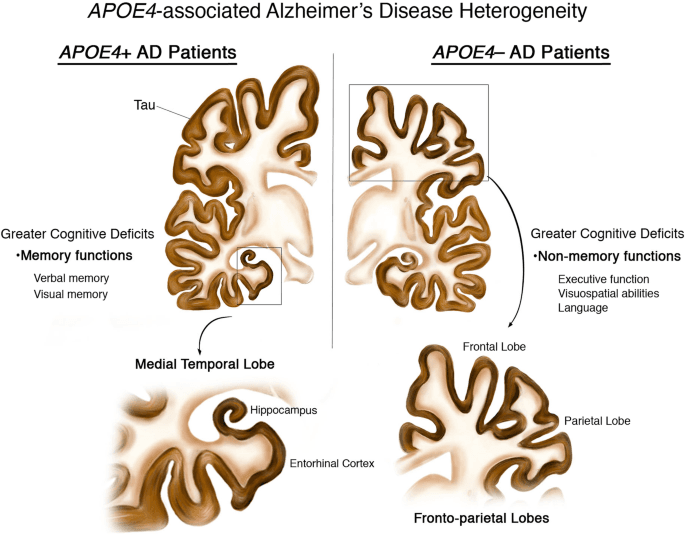
The #1 genetic risk factor
APOE4 is the strongest common genetic risk factor for late-onset Alzheimer's. It affects how your brain clears amyloid-beta, a protein linked to the disease.
Also affects your heart
APOE4 carriers tend to have higher LDL cholesterol levels. Knowing your status helps you and your doctor monitor cardiovascular health proactively.
Not everyone gets Alzheimer's
Many APOE4 carriers live to 90+ without cognitive decline. Your genes load the gun, but lifestyle, diet, sleep, and exercise pull — or don't pull — the trigger.
Lifestyle makes a real difference
The Lancet Commission found that up to 40% of dementia cases could be prevented or delayed through modifiable lifestyle factors. APOE4 carriers benefit the most.
Find out your APOE status in 2 minutes.
Same file you already have from 23andMe or AncestryDNA.
What the numbers actually mean
Risk is not destiny. Here's what each APOE genotype means for your lifetime Alzheimer's risk — and why context matters more than the number.
No APOE4 copies
~75% of people
General population baseline
One APOE4 copy
~25% of people
Increased risk, not certainty
Two APOE4 copies
~2-3% of people
Higher risk, but many never develop it
Important:These numbers come from population-level studies. Your individual risk depends on family history, lifestyle, other genetic factors, and environmental exposures. APOE4 status alone does not predict whether you will develop Alzheimer's. Always discuss your results with a healthcare professional.
Knowledge is power, not panic
Research shows APOE4 carriers who take action can dramatically reduce their risk. Here are four evidence-based strategies.

Regular exercise
150+ minutes/week of aerobic exercise reduces Alzheimer's risk by up to 45% in APOE4 carriers. The Lancet Commission (2020) lists physical inactivity as the #1 modifiable dementia risk factor.
Source: Lancet 2020; JAMA Neurology 2019
Quality sleep
7-8 hours of sleep helps clear amyloid-beta from the brain. Poor sleep doubles Alzheimer's risk regardless of genotype. Sleep is when your brain takes out the trash.
Source: Science 2013; JAMA Neurology 2020
Mediterranean diet
The MIND diet (Mediterranean + DASH) reduces Alzheimer's risk by up to 53% even with partial adherence. Omega-3 fatty acids, leafy greens, and berries are especially protective.
Source: Alzheimer's & Dementia 2015
Cognitive engagement
Bilingualism, learning new skills, and social engagement build cognitive reserve. Higher education and lifelong learning delay symptom onset by 5-7 years in APOE4 carriers.
Source: Neurology 2020; Lancet Commission 2020
Check your APOE status. Then take action.
Upload your 23andMe or AncestryDNA file. Results in 2 minutes.
Three steps to your APOE status
Upload your DNA file
23andMe, AncestryDNA, Nebula, MyHeritage, or any VCF file. It takes 30 seconds.
We check your APOE genotype
We read rs429358 and rs7412 from your file and cross-reference with ClinVar, gnomAD, and 13 more medical sources.
Get your full report
APOE status, risk context, evidence-based lifestyle recommendations, and a physician-ready summary you can bring to your doctor.
Why people choose to know
I found out I'm APOE4/4. The initial panic was real. But then I used it as motivation — changed my diet, started exercising daily. My neurologist said I'm doing everything right.
— Reddit user
My mom has Alzheimer's. I needed to know if I carry the gene. Not to panic, but to prepare. Knowing is better than wondering.
— Reddit user
Getting tested was the push I needed to finally take my health seriously. I sleep better, eat better, exercise more. Knowledge changed my behavior.
— Reddit user
~25%
of people carry at least one APOE4
40%
of dementia is potentially preventable
45%
risk reduction with regular exercise
15
medical sources cross-referenced
Common questions
Risk factor,
not destiny.
Knowing your APOE status is the first step toward prevention. Your DNA data doesn't change — but what you do with it can change everything.